Choose how many teams play for the top places
In a tournament with forty teams, often only a small group plays for the prizes after the group
stage. The top eight play quarter-finals, semi-finals and finals; the rest are dealt with in small
groups of four. But what if you also want to give the teams in 9th to 16th place a full final round?
With the tournament type Groups | Top 8: Quarter-finals and Placement Matches | Remaining Teams: Cross-over and Consolation Finals per 4 Teams
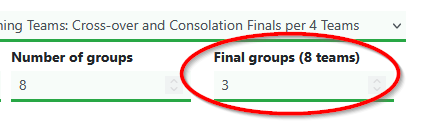
you now choose how many teams play in final groups of 8: 8, 16, 24 or more. The
other teams play cross-over and consolation finals per 4.
How it works
After the group stage, teams are divided based on their group position. The best teams go into
final groups of 8. Each group plays quarter-finals, semi-finals and finals, so that all eight places
in the group are played for. With two final groups, the top eight play for places 1 to 8 and the
next eight for places 9 to 16.
The remaining teams play in groups of 4: two semi-finals and two finals per group. Every place is
played for there as well. If the number of remaining teams is not a multiple of four, the last
group automatically gets a suitable, smaller format.
The trade-off: more final groups or a shorter schedule
A team in a final group of 8 plays three matches after the group stage. A team in a
group of 4 plays two. Each extra final group therefore gives eight teams one more
match and a finer ranking, but also makes the schedule four matches longer.
An example with 40 teams in 8 groups of 5. The group stage has 80 matches; after that:
| Final groups of 8 |
Teams per 8 |
Teams per 4 |
Matches after the group stage |
Total |
| 1 | 8 | 32 | 44 | 124 |
| 2 | 16 | 24 | 48 | 128 |
| 3 | 24 | 16 | 52 | 132 |
| 4 | 32 | 8 | 56 | 136 |
| 5 | 40 | 0 | 60 | 140 |
With 40 teams, the difference between one and five final groups is therefore 16 matches. With
several pitches in parallel, that is often just one extra round of play.
Which teams go into the final groups?
The split follows the final group standings. With 40 teams in 8 groups and two final groups, the
group winners play in the first final group and the runners-up in the second. If a group position
does not fit entirely into a final group, the mutual ranking decides who still gets in:
Best no. 3 (2) is, for example, the second-best third-placed team across all groups.
Try it yourself
Switch between top 8, top 16 and top 24 and
see straight away what changes in the schedule.
On the demo page you choose the number of teams, the number of groups and the number of final
groups. The graphical view shows every match, with lines showing where winners and losers go next,
and the key figures give the number of matches per stage.
Prefer leagues of 16 teams? Then read
Quarter finals and play-offs per 16 teams.
How to set it up
In the category, choose the tournament type Groups | Top 8: Quarter-finals and Placement Matches | Remaining Teams: Cross-over and Consolation Finals per 4 Teams.

Then enter the number of groups you want under Final groups (8 teams) and generate
the schedule. Existing tournaments with this type stay as they are: they have one final group.
No account yet? Register for free or log in,
create a tournament and try it out. You then manage pitches, results and standings in one place;
visitors follow the up-to-date schedule online.